Trusted annual DOT inspections in Blooming Prairie, MN, have helped commercial drivers stay ready since 2002
Nothing derails a workday faster than a failed inspection, a roadside violation, or an out-of-service order caused by a defect that could have been corrected earlier. For an independent contractor, farmer, delivery driver, or fleet manager, the lost revenue often costs more than the repair itself.
Darrick’s Preferred Auto has served Blooming Prairie and nearby communities since 2002. Located at 540 US-218 and led by Darrick Schewe, the shop provides qualified annual DOT inspection services and commercial vehicle repairs for customers from Hayfield, Ellendale, Owatonna, Austin, Albert Lea, and across southern Minnesota. The team’s working philosophy remains simple: “Fix it fast, fix it RIGHT, and get it to you at a fair price.”
As an ASE Blue Seal Shop and NAPA AutoCare Center, Darrick’s Preferred Auto combines qualified technicians, detailed inspection procedures, and practical repair experience. The annual periodic commercial vehicle inspection performed at the shop is different from a roadside enforcement inspection. It is a documented safety review designed to identify conditions that could cause a breakdown, compliance problem, or costly interruption to business operations.
The smartest commercial operators do not treat inspection day as the first time anyone looks closely at the vehicle. They use inspections as part of a larger maintenance plan that protects drivers, customers, equipment, and schedules.
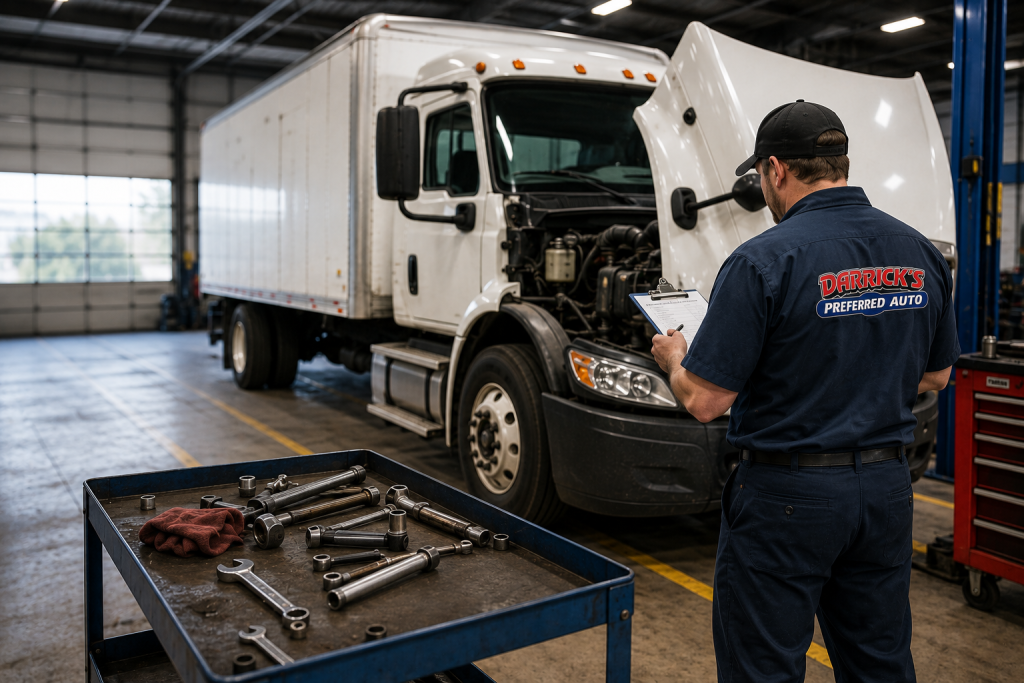
Annual DOT inspections near Blooming Prairie, MN, verify whether covered commercial vehicles meet minimum safety requirements
What is an annual DOT inspection?
An annual DOT inspection is a documented periodic examination of a commercial motor vehicle’s safety-related systems and components. Under federal rules, covered commercial vehicles must receive a periodic inspection at least once every 12 months, and each vehicle in a combination must be inspected. The inspection must meet the minimum standards in 49 CFR Part 396.
The federal periodic inspection requirements require the inspection to cover the parts and accessories listed in Appendix A to Part 396. That includes brakes, steering, suspension, tires, wheels, lighting, frame components, coupling devices, exhaust systems, and other safety-critical items.
Not every truck used for work falls under the same rules. Coverage depends on factors such as vehicle weight rating, combination weight, interstate or intrastate operation, passenger capacity, and the type of cargo being transported. Some covered farm vehicles may qualify for federal exemptions, but eligibility depends on ownership, operation, vehicle size, cargo, distance traveled, and other conditions. Minnesota requirements may also apply, so operators should confirm their specific obligations with the appropriate regulatory authority.
| Why this matters A valid annual inspection does not guarantee that a vehicle will pass a roadside inspection months later. The vehicle must remain in safe operating condition every day, not only on the date the annual inspection is completed. |
In our shop, we commonly see commercial drivers who believe the inspection sticker is the entire compliance program. In reality, the sticker documents that the vehicle met the applicable standard at the time of inspection. Daily use, heavy hauling, gravel roads, weather, corrosion, and normal component wear can create new defects afterward.
Common annual DOT inspection failures in southern Minnesota often begin as small maintenance problems
A local contractor once scheduled what he expected to be a routine inspection on a three-quarter-ton work truck. The truck still stopped normally and had no warning lights, but inspection revealed uneven rear brake wear and a cracked flexible hose beginning to deteriorate near a fitting. Neither issue had caused a breakdown yet, but both needed attention before the vehicle was ready to pass.
That situation is typical. Many inspection failures are not dramatic. They are worn, loose, leaking, damaged, or inoperative components that become obvious only when the vehicle is examined methodically.
Brake system defects are among the most serious findings
Brake problems may involve worn friction material, damaged rotors or drums, leaking hydraulic components, contaminated linings, excessive pushrod travel, cracked air lines, loose chambers, or parking brakes that do not hold correctly. A driver may not notice gradual loss of performance because the change happens over thousands of miles.
On Ford F-350, Chevrolet Silverado 2500HD, GMC Sierra HD, and Ram 3500 work trucks, heavy trailers and frequent stop-and-go use accelerate brake wear. Proper brake inspection requires more than looking through a wheel opening. Technicians evaluate the system as a whole, including hoses, hardware, mounting, adjustment, leakage, and actual stopping concerns.
Tire and wheel problems can turn into immediate downtime
Low tread depth, exposed cords, sidewall damage, underinflation, mismatched tires, loose wheel fasteners, cracked rims, and abnormal wear patterns can all create inspection problems. Uneven shoulder wear often points to alignment or steering concerns rather than a tire problem alone.
Commercial tires also carry heavy loads for long periods. Heat buildup, underinflation, and gravel-road impacts can weaken a casing before the tire looks obviously unsafe. Catching that damage during routine tire service is far less expensive than handling a roadside failure with a loaded truck or trailer.
Lighting and electrical defects are easy to overlook
A marker lamp that worked yesterday may fail after vibration, moisture intrusion, corrosion, or a damaged ground connection. Replacing a bulb does not solve the problem if voltage drop in the circuit prevents the lamp from receiving full power.
Our technicians frequently use voltage drop testing and current draw testing when repeated lighting failures point to wiring, connectors, trailer plugs, or grounding problems. This is faster and more reliable than replacing bulbs and fuses repeatedly without finding the cause.
Steering, suspension, and frame concerns worsen under rural use
Loose tie-rod ends, worn ball joints, broken springs, damaged bushings, leaking shocks, shifted axle components, and frame corrosion can affect directional control and tire wear. Gravel roads and frost-heaved pavement place repeated impact loads on these parts.
A vehicle may still feel acceptable to a driver who uses it every day because the change develops gradually. An inspection establishes a more objective view of wear, movement, mounting condition, and structural integrity.
Leaks and emergency equipment create preventable failures
Engine oil, coolant, fuel, brake fluid, power steering fluid, and transmission leaks require careful evaluation. A light film of residue is not the same as an active leak, but fresh fluid collecting or dripping near hot components, tires, brakes, or the roadway is a safety concern.
Missing or expired fire extinguishers, unsecured equipment, damaged reflective devices, poor wiper operation, and windshield damage can also create compliance problems. These items are inexpensive to correct when discovered early and frustrating when found at the last minute.
An annual DOT inspection checklist shows how thoroughly each safety system must be examined
Most drivers are surprised by how much detail goes into a proper annual inspection. Inspectors are not simply checking whether a part is present. They are evaluating wear, operation, mounting, adjustment, leakage, damage, and whether the component meets the minimum inspection standard.
| System | What is examined | Common concerns |
|---|---|---|
| Brakes | Service brakes, parking brake, hoses, lines, chambers, drums or rotors, friction material | Leaks, wear, poor adjustment, damaged components |
| Tires and wheels | Tread, inflation, sidewalls, rims, hubs, wheel fasteners | Low tread, exposed cords, damage, looseness |
| Steering | Steering gear, linkage, joints, mounting, free play | Loose joints, excessive play, fluid leaks |
| Suspension | Springs, hangers, shackles, U-bolts, shocks, bushings | Cracks, movement, broken or displaced parts |
| Lighting | Headlamps, brake lamps, turn signals, markers, reflectors | Inoperative lamps, corrosion, wiring faults |
| Windshield and wipers | Glass condition, visibility, washer and wiper operation | Cracks, weak blades, blocked field of view |
| Frame and coupling | Frame rails, crossmembers, fifth wheel or hitch components | Cracks, corrosion, loose or damaged mounting |
| Fuel and exhaust | Fuel system integrity, exhaust routing, leaks and mounting | Fuel leakage, damaged exhaust, unsafe routing |
| Emergency equipment | Fire extinguisher, warning devices and required equipment | Missing, expired, damaged, or unsecured items |
The qualified inspector must prepare a report that identifies the inspector, carrier, vehicle, date, components inspected, and results. Federal recordkeeping rules generally require the motor carrier to retain the report for 14 months, while documentation of the most recent inspection must be kept on the vehicle. The FMCSA vehicle inspection guidance explains these responsibilities in more detail.
Preventive maintenance helps Blooming Prairie fleet owners pass annual DOT inspections with less downtime
Waiting until inspection day to think about maintenance is usually the most expensive approach. If an inspector finds worn brakes, damaged tires, loose steering components, or lighting faults a day before a truck is needed for a job, the operator has very little scheduling flexibility.
A better approach is to combine annual inspections with a written preventive maintenance schedule based on mileage, engine hours, operating conditions, seasonal use, and the type of work the vehicle performs. A delivery van that makes short trips all day does not wear components the same way as a farm truck that pulls heavy trailers on gravel roads.
Routine commercial vehicle maintenance should include brake measurements, tire pressure and tread tracking, steering and suspension checks, battery and charging system testing, fluid inspections, lighting checks, and review of any driver-reported defects. This creates a service history that helps technicians identify wear trends before they interrupt operations.
One of the most useful fleet practices is recording what was measured, not simply noting that something was ‘checked.’ If rear brake lining measured 8 millimeters last visit and 5 millimeters now, the fleet owner can plan the repair instead of waiting for the component to reach a critical condition during the busiest week of the season.
An annual DOT inspection and routine vehicle maintenance serve different purposes even when some checks overlap
Is a recent oil change enough to prepare a truck for an annual DOT inspection?
No. Routine maintenance keeps a vehicle operating efficiently, while an annual DOT inspection verifies that required safety components meet minimum regulatory standards. An oil change may include a courtesy check, but it does not replace the documented periodic inspection required for covered commercial vehicles.
This distinction matters because normal maintenance often focuses on what is due by time or mileage: engine oil, filters, fluids, belts, batteries, or scheduled services. An annual DOT inspection focuses on the compliance-related safety condition of the entire vehicle or combination.
The two processes support each other. Maintenance reduces the likelihood of defects, and the inspection provides a formal, documented review. Neither process replaces the daily responsibility to keep the vehicle safe.
| Mechanic insight A truck can be mechanically dependable and still fail an inspection for a compliance defect, such as an inoperative marker lamp or missing emergency equipment. It can also have a current annual inspection and later develop a brake, tire, or steering defect that makes it unsafe to operate. |
Commercial vehicle repair in Blooming Prairie, MN, should correct the root cause before it becomes a violation
A loose brake chamber, damaged spring hanger, slow air leak, or intermittent trailer light rarely improves with time. Delaying the repair allows vibration, heat, corrosion, and load cycles to enlarge the problem. The eventual repair may require more parts and create more downtime than the original defect would have.
At Darrick’s Preferred Auto, inspection findings can be explained in practical terms so the operator understands what failed, why it matters, and what should be repaired first. Same-day repairs may be possible depending on the defect, parts availability, and the shop schedule.
Common commercial vehicle repairs include brake repair and maintenance, steering and suspension service, tire replacement and repair, lighting and electrical diagnosis, fluid leak repair, and general undercarriage work.
Accurate diagnosis is especially important for electrical problems. If multiple trailer lamps fail intermittently, replacing each lamp may waste time if the actual cause is voltage drop in a corroded ground circuit or damaged connector. Using circuit testing, current draw measurements, and wiring diagrams finds the root cause faster and reduces repeat failures.
The same principle applies to brake wear. Installing new friction material without identifying a sticking caliper, weak hose, seized adjuster, or mechanical imbalance can allow the new parts to fail early. Proper repair solves the reason the component wore abnormally, not only the visible symptom.
Local businesses trust Darrick’s Preferred Auto for annual DOT inspections because clear answers reduce uncertainty
Many commercial customers first arrive for an inspection and continue returning because the shop can handle both the inspection and the repair work that keeps the vehicle dependable afterward. That continuity matters for fleets because technicians become familiar with each unit’s history, use patterns, and recurring wear concerns.
Darrick’s Preferred Auto has served Blooming Prairie since 2002 and has grown from a one-person operation into a team of 15 employees. The shop is an ASE Blue Seal facility and NAPA AutoCare Center, and its experienced team includes qualified inspection personnel who understand both the annual inspection criteria and the realities of commercial vehicle use.experienced team includes DOT inspection personnel
Fleet owners and contractors also value fast scheduling, transparent estimates, and recommendations based on safety and actual condition rather than unnecessary upselling. When repairs are needed, the goal is to explain the options clearly and return the vehicle to service as efficiently as the situation allows.
Free rides, pickup and delivery where appropriate, and practical scheduling support can also reduce disruption. These services are especially helpful for small businesses that do not have spare vehicles or a full-time fleet maintenance department.
Rural Minnesota driving creates DOT inspection challenges that highway-only fleets may not experience
Commercial vehicles in southern Minnesota face a demanding combination of gravel roads, farm traffic, heavy hauling, road salt, freeze-thaw cycles, and long rural routes. These conditions create wear patterns that may not appear as quickly in vehicles operating mainly on smooth interstate pavement.
Gravel dust works into brake hardware, electrical connectors, air filters, and moving suspension parts. Repeated washboard vibration loosens fasteners and stresses wiring. Mud and crop debris can conceal leaks or damage during harvest season, while road salt accelerates corrosion around brake lines, frame mounting points, electrical grounds, and trailer connectors.
Frost heaves and potholes add sharp impact loads to steering linkage, springs, wheel bearings, tires, and alignment angles. A driver may notice the steering wheel sitting slightly off-center or the truck beginning to pull before the underlying wear becomes obvious.
Heavy hauling creates another layer of stress. A Chevrolet Silverado 3500, Ford F-350, GMC Sierra HD, or medium-duty delivery truck may pass an inspection when unloaded but reveal symptoms under working load. Brake pull, steering wander, driveline vibration, heat-related tire concerns, and electrical charging issues often become clearer when the vehicle is operated the way the business actually uses it.
That is why a good inspection starts with questions about the route, cargo, trailer, season, and recent symptoms. The same vehicle can develop very different needs depending on whether it carries tools around Blooming Prairie, pulls livestock trailers near Hayfield, or runs daily deliveries toward Owatonna and Austin.
The best time to schedule an annual DOT inspection is several weeks before the current inspection expires
One of the biggest mistakes fleet owners make is waiting until the final week. That leaves little time to source parts, schedule repairs, reinspect the vehicle, or adjust work assignments if an unexpected defect is discovered.
Scheduling early does not shorten the useful life of the existing inspection in a meaningful way, but it creates breathing room. For seasonal businesses, the best appointment is usually before the busiest hauling, construction, or delivery period begins.
Between annual inspections, drivers and managers should use a simple routine that catches common failures early:
- Perform consistent walk-around checks and document defects.
- Test all lamps and trailer connections weekly.
- Watch tire pressure, tread wear, sidewall damage, and wheel condition.
- Investigate air loss, fluid spots, warning lights, and new noises promptly.
- Have steering changes, brake pull, vibration, or unusual handling inspected.
- Keep maintenance and inspection records organized by vehicle.
- Schedule annual inspections before the deadline rather than at the deadline.
If a roadside inspector places a vehicle out of service, the safety defect must be corrected before the vehicle is operated again. FMCSA guidance also requires the driver to deliver the roadside inspection report to the motor carrier, and the carrier must complete the required correction and certification process. The Commercial Vehicle Safety Alliance out-of-service criteria are used by enforcement personnel during roadside inspections; they are separate from the annual periodic inspection performed by a repair facility.Commercial Vehicle Safety Alliance out-of-service criteria
Frequently asked questions about annual DOT inspections near Blooming Prairie, MN, help operators prepare with fewer surprises
Who needs an annual DOT inspection?
Covered commercial motor vehicles generally must receive a periodic inspection at least once every 12 months. Whether a specific truck, trailer, van, bus, or combination is covered depends on its ratings, use, cargo, passenger capacity, and whether it operates in interstate or intrastate commerce. Farm and specialized vehicles may have exemptions, so operators should verify the rules that apply to their operation.
How often is an annual DOT inspection required?
Federal rules require covered commercial motor vehicles to be inspected at least once every 12 months. Each vehicle in a combination, including trailers and converter dollies when applicable, must be inspected. A carrier may choose to inspect more often based on mileage, use, or operating conditions, but the annual inspection is the minimum federal interval.
How long does an annual DOT inspection take?
Inspection time depends on vehicle type, condition, accessibility, and whether the inspector discovers defects that require additional evaluation. A straightforward light-duty commercial truck may take less time than a truck-and-trailer combination or a vehicle with air brakes. Scheduling enough time for a thorough inspection is more important than rushing to meet a fixed estimate.
What happens if my vehicle fails the inspection?
The inspector documents any components that do not meet the minimum standard. Those defects must be repaired before the vehicle can be documented as passing the annual inspection. If Darrick’s Preferred Auto can complete the repairs, the shop will explain the findings, provide an estimate, and discuss timing based on parts availability and the work required.
Can repairs be completed the same day?
Some repairs can be completed the same day, especially lighting faults, minor wiring repairs, certain brake work, fluid leaks, or tire concerns when parts are available. More complex steering, suspension, air brake, frame, or electrical problems may take longer. Scheduling before the inspection expires gives the shop and operator more flexibility.
What is the difference between an annual DOT inspection and preventive maintenance?
Preventive maintenance is an ongoing plan that reduces wear and breakdowns through scheduled service and condition checks. An annual DOT inspection is a formal compliance inspection of required safety components. Maintenance improves the chances of passing, but it does not replace the documented annual inspection for a covered vehicle.
How should I prepare for an annual DOT inspection?
Review recent driver reports, verify that all lights operate, check tires and wheels, look for leaks, test the parking brake, confirm that required emergency equipment is present, and bring relevant vehicle information. Do not clear warning lights or hide symptoms. Accurate information helps the inspector evaluate the vehicle efficiently.
What paperwork should I bring?
Bring vehicle identification and registration information, carrier information, prior inspection documentation if available, and any service records related to recent repairs or reported defects. The inspector will need enough information to identify the vehicle and carrier accurately on the annual inspection report.
Does a current annual inspection guarantee I will pass a roadside inspection?
No. The annual inspection shows that the vehicle met the standard on the date it was inspected. A lamp can fail, a tire can be damaged, or a brake defect can develop afterward. Drivers and carriers remain responsible for keeping the vehicle safe and compliant throughout the year.
Can a warning light cause an annual DOT inspection failure?
A warning light is not evaluated in isolation. The inspector must determine what system is affected and whether the underlying condition violates the applicable inspection standard or creates an unsafe condition. Warning lights should be diagnosed before inspection because they may point to brake, engine, emissions, electrical, or communication faults.
Are farm trucks always exempt from annual DOT inspection rules?
No. Some covered farm vehicles may qualify for federal exemptions, but eligibility depends on ownership, operation, vehicle size, cargo, distance traveled, and other conditions. Agricultural use alone does not automatically exempt every truck or trailer, and Minnesota requirements may also apply. Operators should confirm their specific obligations with the appropriate regulatory authority.
Why should fleet owners use the same shop for inspections and maintenance?
A consistent repair history helps technicians recognize patterns in brake wear, tire wear, corrosion, electrical problems, and recurring driver complaints. That knowledge supports better planning and reduces duplicated diagnostic work. It also gives the fleet owner one place to review inspection findings, prioritize repairs, and plan future service.
Schedule your annual DOT inspection in Blooming Prairie, MN, before small problems create costly downtime
Every hour a commercial vehicle is unexpectedly out of service is time that cannot be spent serving customers, making deliveries, hauling equipment, or completing scheduled work. Planning the inspection early gives you time to address wear before it becomes an emergency.
Darrick’s Preferred Auto provides professional vehicle inspections and commercial vehicle repairs for drivers and businesses throughout Blooming Prairie, Hayfield, Ellendale, Owatonna, Austin, Albert Lea, and surrounding southern Minnesota communities. As an ASE Blue Seal Shop and NAPA AutoCare Center, Darrick’s Preferred Auto offers honest recommendations, experienced technicians, and fast turnaround whenever the repair and parts availability allow.professional vehicle inspections
Call 507-583-9994 to discuss your vehicle or request an inspection appointment before the current inspection expires.
Visit Darrick’s Preferred Auto at 540 US-218, Blooming Prairie, MN 55917. Pickup and delivery may be available where appropriate, and the team can explain any inspection findings clearly before repairs begin.
For maintenance reminders, local shop updates, and seasonal vehicle information, follow Darrick’s Preferred Auto on Facebook.
Schedule the inspection with enough time to correct unexpected issues, protect your work schedule, and keep your commercial vehicle safely on the road.